The Editor: How Publishing Legend Judith Jones Shaped Culture in America by Sara B. Franklin
One of my goals for 2026 is to read more nonfiction, and to pick up more books by male authors (I’ve been focusing on a lot more stories by women in recent years). I’m off to a great start already—completed John Grisham’s latest novel and a heartfelt memoir by Cameron Crowe. While asking one of my colleagues at Main Street Books for some nonfiction recommendations, she was happy to oblige.
I picked up “The Editor: How Publishing Legend Judith Jones Shaped Culture in America.” I was interested in learning more about Jones, because I’d never before heard about this woman who was considered such a trailblazer in the publishing world.
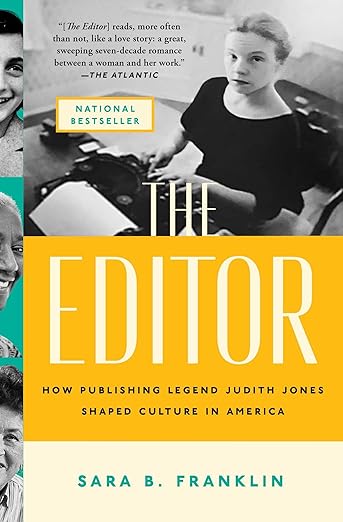
Synopsis:
At Doubleday’s Paris office in 1949, twenty-five-year-old Judith Jones spent most of her time wading through manuscripts in the slush pile and passing on projects—until one day, a book caught her eye. She read it in one sitting, then begged her boss to consider publishing it. A year later, Anne Frank: The Diary of a Young Girl became a bestseller. It was the start of a culture-defining career in publishing.
During her more than fifty years as an editor at Alfred A. Knopf, Jones nurtured the careers of literary icons such as Sylvia Plath, Anne Tyler, and John Updike, and helped launched new genres and trends in literature. At the forefront of the cookbook revolution, she published the who’s who of food writing: Edna Lewis, M.F.K. Fisher, Claudia Roden, Madhur Jaffrey, James Beard, and, most famously, Julia Child. Through her tenacious work behind the scenes, Jones helped turn these authors into household names, changing cultural mores and expectations along the way.
While the book’s author Sara B. Franklin had read Judith’s memoir “The Tenth Muse: My Life in Food,” while she was in college, she didn’t meet the esteemed editor until Judith was 88 years old, when Franklin received a grant from the National Endowment for the Humanities to interview and archive an oral history of the editor’s life.
“The Editor” is a comprehensive look at Judith’s life, from her privileged upbringing in Manhattan and Vermont to her studies at Bennington College, an internship at DoubleDay, to her courageous journey to Paris in her early 20s to live and find work in publishing. It was there Judith first discovered her love of food and cooking, two things that would help shape both her professional and personal life. She and her friends had to get creative to support themselves and indulge in the French cuisine they loved—they even opened their own “unofficial” restaurant in an apartment they were renting. It was clear early on that Judith was also a natural networker, she made friends and professional connections everywhere she went. She loved fiercely, she never shied away from a challenge, and she brought out the best in every writer she worked with. I loved hearing the personal stories of how she first met Julia Child and helped shape her career with “Mastering the Art of French Cooking,” a project that took place over a number of years before it was finally published.
Franklin notes in her book:The scope of editors’ role is little understood, even by the most avid readers. Editors’ work extends far beyond moving words around on a page. They are shepherds of individual authors careers, and responsible for the literary landscape as a whole. They must, at once, remain laser focused on their writers’ specific needs, while keeping abreast of shifts in the culture at large.
Judith earned her place in publishing in a time where women weren’t widely recognized in the industry, and she worked steadily until she was in her mid-80s. She recognized the importance of cookbooks before they graced so many shelves of bookstores, and she wanted them to be much more than recipes and images on a page. She cultivated lasting relationships with authors such as Anne Tyler and John Updike. Having just read “The Correspondent” by Virginia Evans, I couldn’t help but appreciate the glimpses of correspondence between Judith, the authors she worked with, and other industry professionals. She always chose her words carefully, but she had such a gentle touch with her editor’s pen and way of explaining how the author could improve their work that she endeared herself to so many people.
Judith Jones didn’t necessarily consider herself a feminist, but she didn’t want women who liked to cook to be pigeonholed into the box of simply being a “housewife.” In fact, her cookbook authors were much more than that—they were creators and artisans who hoped to share their cultures with readers as well as their recipes. Judith learned from every single author she worked with, and recognized how much it enriched her life.
The Editor lived a truly fascinating life, and it spanned an impressive amount of decades. I enjoyed learning about her adventures in travel, cooking, work, and the lasting friendships she made along the way. She was a truly unique person and a great subject for a biography—I only wish she would have been recognized more while she was still alive.