The Unsolved Murder of Cynthia Kirk
On Monday, Aug. 21, 1989, the quiet Durham neighborhood of American Village was stunned when a 34-year-old mother was found murdered in her home. Cynthia Kirk, a married mother of a nineteen-month-old daughter, worked as a second-shift supervisor at the tobacco company Liggett & Myers. Normally, she would pack a diaper bag for her daughter, Suzanne, before taking her over to a babysitter’s house around 2:15 p.m.. But on the afternoon of August 21, Cynthia, known as Cindy to her friends and family, and Suzanne never arrived at the babysitter’s home. Concerned, the sitter tried to call Cindy. When she couldn’t reach her, she phoned Cindy’s sister, Beverly Sechler, who lived nearby.
When Beverly arrived at the home on Constitution Drive around 3:30 p.m. she knew something was terribly wrong. She spotted blood on the driveway and side porch of the home. Nervous, she asked one of her sister’s neighbors to go into the house. That neighbor found Cindy lying in the doorway leading into the kitchen, covered in blood. Investigators later determined Cindy had been stabbed several times in the chest. There was no sign of an attempted sexual assault. Nothing had been taken from the home. Her daughter Suzanne was still sleeping in her bedroom, upstairs, and had been unharmed. It appeared that Cindy was packing up her car with Suzanne’s belongings when she was confronted by her attacker. Her purse was found on the passenger side of the car.
The attack occurred around 1 p.m. in the afternoon, in a neighborhood not far from the Duke University campus, and in the presence of both a landscaping and construction crew on the street. It was a landscaper who gave the police their most solid lead—he had seen Cindy in her driveway, talking to a clean-cut, middle-aged white male who he later saw driving away from the street in an olive-green sedan.
By early October, members of Cindy’s family were offering $25,000 for information leading to the arrest and indictment of her killer. GKC Associates, the employer of Cynthia’s husband Bill, offered up to $5,000 for information leading to an arrest and indictment. Liggett & Myers Tobacco Co. also offered up to $5,000 in reward for information leading to the arrest, indictment, and conviction of the murderer. CrimeStoppers announced it would pay up to $1,200 for information leading to an arrest and conviction. Cynthia’s brother-in-law, Gary Sechler, was married to her sister Beverly. He worked with Cynthia at Liggett & Myers, and told the media, “You could think of all the superlatives you could say about somebody, and you could say them about her, and they would apply.”
Cindy was born Cynthia Lou Jones and was raised in the Sandy Ridge community of western Guilford County. She met her husband, Bill, when they sat near one another at in first grade at Colfax Elementary School. While they didn’t date while they were in high school, they reconnected years later, after Cindy went off to study textiles at N.C. State and Bill went into the Air Force. After Cindy graduated from college in 1977, they began dating exclusively. They married on June 13, 1981 at Smith Grove Baptist Church in Sandy Ridge. Bill told the News & Record, “It was like two pieces making up one part. She was the best girl I ever knew, and that’s why I married her.”
They settled in Durham after living in Pittsboro and Cary. They favored staying at home but liked going out to dinner with friends and attending church together at Grace Baptist Church, where Cindy sometimes volunteered in the nursery.
When the couple had Suzanne, they shared parenting responsibilities equally, with Cindy staying with their daughter until dropping her off at the babysitter’s house before 3 p.m. Bill, who worked at a consulting and structural-engineering firm, picked her up around 5:30 p.m., caring for her until Cindy returned home from her shift around 11 p.m. After Cindy’s death, Bill told the News and Record, “The thing that this person did to Cindy is just pure evil. It is a mystery as to who did this, but I know it will be solved.”
In the weeks following Cindy’s murder, her neighbors in American Village were understandably concerned. American Village was comprised of around 200 homes, including the Cape Cod style home Cindy and Bill lived in at the time of her murder. Members of the police department attended a meeting of the American Village Women’s Club on September 11, 1989, to try and dispel any rumors that residents had heard and had questions about. Police Corporal F.J. Borden, the CrimeStoppers coordinator, said the police department did not believe Cindy was murdered by a homicidal maniac acting at random.
In mid-September,1989, police began circulating a flier that featured a drawing of the suspect in Cindy’s murder. He was a white male in his mid-30s to early 40s, medium height and weight. He had dark hair. The flier also contained a description of the olive green car with a CB antenna the suspect was believed to have been driving on that afternoon. It resembled a Plymouth Reliant. Detective T.A. Hester said detectives had followed up on numerous tips, but none had led to a suspect.
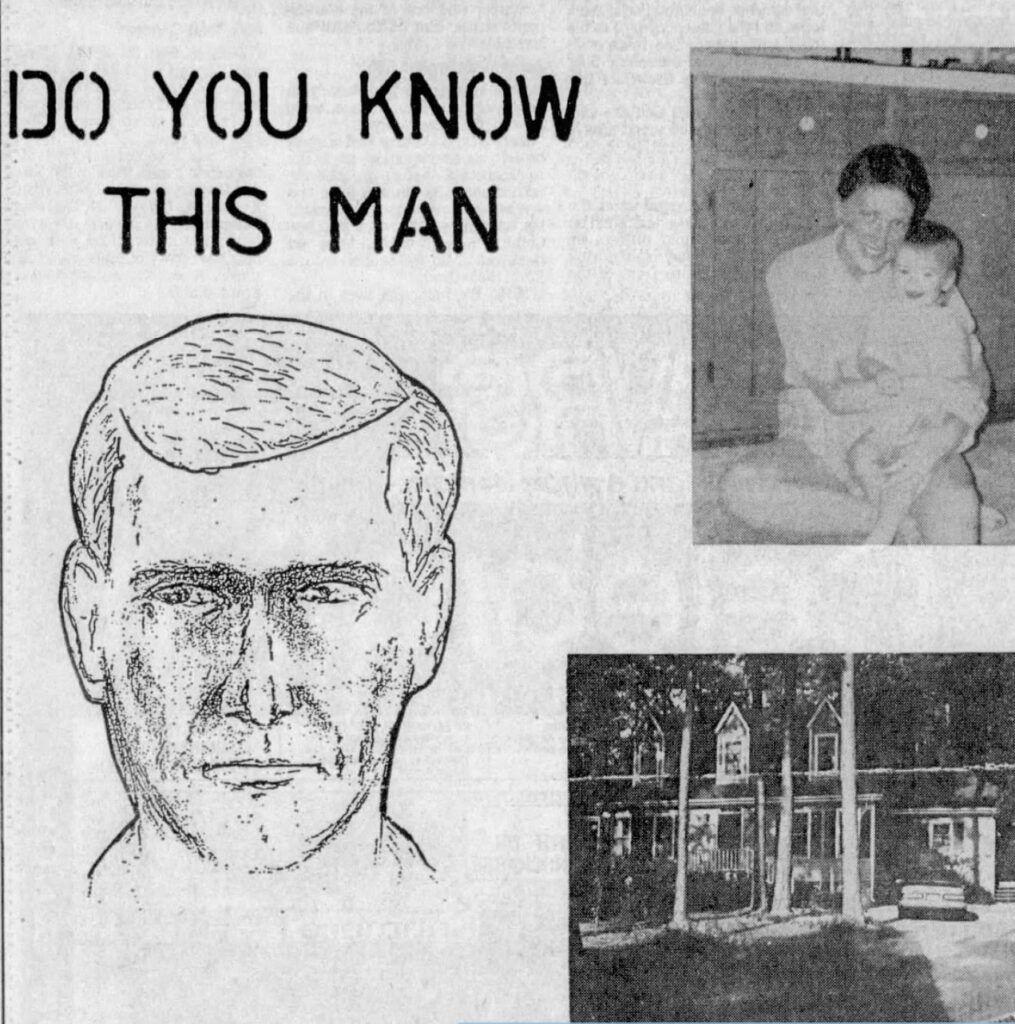
“We don’t know who did it, but we know of a lot of people who didn’t do it,” he said. Police had checked out more than 300 reports of olive green cars in the state, and they distributed fliers in nearby shopping malls, convenience stores, and Duke University.
Despite a door-to-door canvass and search for a murder weapon or any other physical evidence in the crime, police were unable to uncover any other clues other than the suspect and description of his vehicle. They wondered if Cindy had died as the result of a botched attempted abduction.
In mid-March, 1990, detectives with the Durham police department constructed a timeline and re-enactment of what they believed happened on the afternoon Cindy was murdered.
Here’s what they told reporters:
Cindy was getting ready to go to her second shift job at Liggett & Myers Tobacco Company. Suzanne was still asleep in her second-floor bedroom.
Cindy came out the side door of the house by the kitchen and put a diaper bag and her purse on the passenger seat of the car between 1:30 p.m. and 2:15 p.m. Then she locked her car.
A man had parked his car across the street at the end of the Kirk’s driveway. He approached Cindy, and police had a theory on what he might have said to her, based on the eyewitness accounts. They envisioned the conversation going something like this:
“Excuse me, ma’am, can you help me? I’m from out of town and I have relatives living on Constitution Drive and I can’t find their house.” The two spoke briefly in the driveway, and there didn’t appear to be any tension in between them. Then, he grabbed Cindy around the neck and shoved her to the ground. She was stabbed in the chest and back, suffering a defensive wound to her thumb. She screamed loudly during the attack, and someone in the neighborhood did report hearing it later. They thought it was a child who had been hurt and couldn’t tell where the screams were coming from.
Cindy managed to make it back to the side door leading into the kitchen. As she was doing this, her attacker got back in his car and drove off in a normal manner. He was seen turning right onto Westfield Drive. Detective Hester said the total attack took place in under two minutes. Then, Cindy managed to get her door open and crawl inside, where she succumbed to her injuries.
Detectives had a hard time finding any other eyewitnesses during the afternoon of the murder, as many neighbors were either out of town, at work, or at the local swimming pools. They did talk to people from the postal service, utility companies, and construction workers. It was a tip from a landscaper that gave them their most solid lead.
In June of 1990, The Durham Police Department told the media they believed they had a new lead in the stabbing death of Cindy Jones Kirk. A woman from Burlington in Alamance County told police that on August 3, 1989, 18 days before Cindy was murdered, a white male came to her door around 1:30 p.m. and told her he had run out of gas. He needed to borrow some money. The man the Burlington woman described matched the description of the suspect in Cindy’s murder. She described him as being a white male, between 38 and 40 years of age, standing around 5 foot 8 inches to 5 foot ten inches tall. He was clean-cut and wearing khaki pants and a light-colored knit golf shirt. He was driving an olive green four-door Chrysler with a CB antenna on the back. She said she had seen part of the license plate and caught the numbers 6466.
The new witness said she believed the man was lying about being out of gas, because his car was in her driveway and there was a gas station not far from her house. But, she was in a hurry to get to an appointment, so she gave him some money. When she saw an article in the Greensboro News & Record about the police describing the re-enactment of Cindy’s murder, she remembered the man and decided to contact the police. Because of Alamance County’s proximity to Durham, the police believed this could be a solid lead. Was the suspect working up his nerve to commit murder in this August 8 visit?
After 1991, it was difficult to find any other information about the status of this cold case until 2009, when local news station WRAL covered the story. It shared the details of the murder, and that Cindy’s husband Bill had been ruled out as a suspect because he’d been at work. The police were never able to uncover a motive in the murder, or find the suspect from the composite sketch. In 2019, reporter Amanda Lamb ran another update, this time featuring an interview with Beverly and Gary Sechler, Cindy’s sister and brother-in-law. The Sechlers told WRAL they believed someone who knew Cindy’s schedule and daily habits murdered her. They did say they had questions about Bill, Cindy’s husband, because he remarried not long after her death and collected $400,000 in life insurance after the murder. The Sechlers believed police should interview people in the Kirk’s inner circle to see if anyone knew anything. Bill Kirk told Amanda Lamb that he’d made peace with his former wife’s death, and that he would never forget the traumatic event, but he’s accepted that if the killer is still alive, he will never be caught. The case remains open.
Cynthia Kirk’s story appeared in Ep. 152 of the Missing in the Carolinas podcast.